Concrete thickness, PSI, rebar and gravel guide
Four choices decide how long a slab lasts: how thick it is, how strong the mix is, what reinforces it and what sits under it. Here are plain answers for the jobs we do around Pittsburgh, so you can read a quote and know what you are getting.
Updated
| Job | Thickness | PSI | Steel | Base |
|---|---|---|---|---|
| Sidewalk | 4 in | 3,500 to 4,000 | Optional | 4 in stone |
| Patio | 4 in | 3,500 to 4,000 | Mesh or rebar | 4 in stone |
| Driveway | 4 to 6 in | 4,000 | Rebar or mesh | 4 to 6 in stone |
| Garage floor | 4 to 5 in | 4,000 | Rebar or mesh | 4 to 6 in stone |
| Shed pad | 4 in | 3,500 to 4,000 | Mesh | 4 in stone |
| Shop floor | 5 to 6 in | 4,000 to 4,500 | Rebar | 6 in stone |
| House slab | 4 in | 3,000 to 4,000 | As drawn | 4 in stone, barrier |
| Footers | 8 to 12 in | 3,000 to 4,000 | Rebar | Firm soil |
What does PSI mean?
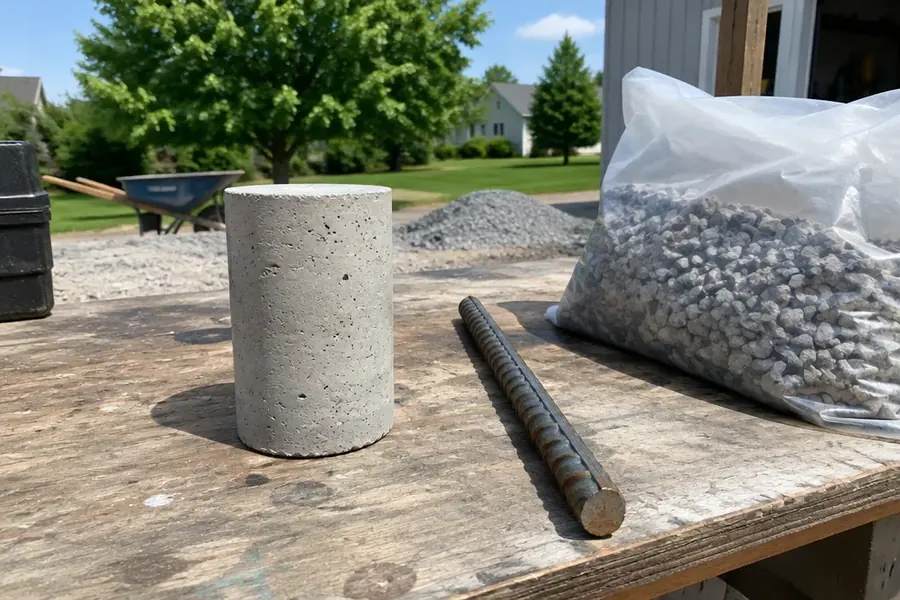
PSI stands for pounds per square inch. It tells you how much crushing force a cured mix can take. Higher isn't always better. It costs more, can shrink more and doesn't help if the slab is on a poor base. Most home jobs in Pittsburgh use 3,500 to 4,000 PSI, with air entrainment for anything exposed to weather.
Air-entrained concrete
This is the single most important choice in our climate. Air entrainment adds billions of tiny bubbles to the mix. When water freezes inside the concrete, those bubbles give it room to expand, so the surface doesn't flake. Any outdoor concrete in Western Pennsylvania should be air-entrained, at about 5 to 7 percent air. It is cheap insurance, and if a quote doesn't mention it, ask.
Water matters too. Adding water at the truck makes concrete easier to place, but it weakens it. A little is fine if the supplier's ticket allows it. Too much can knock hundreds of PSI off the strength. The mix should arrive right, not be fixed with a hose.
Does concrete need rebar?
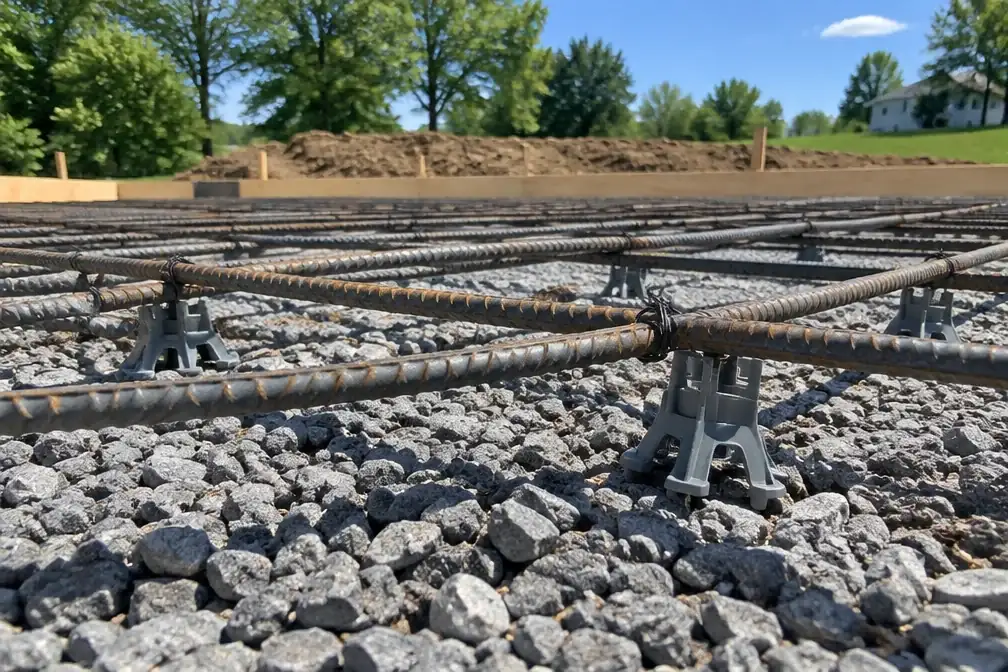
Not all concrete needs it, but most slabs that carry vehicles benefit from it. Steel doesn't stop concrete from cracking. It holds cracks tight and keeps both sides level. That helps a lot on our clay and on slopes.
| Reinforcement | What it does | Use it for |
|---|---|---|
| #3 or #4 rebar grid | Strongest, holds slab together | Driveways, garages, shops |
| Wire mesh | Holds surface cracks tight | Patios, pads, small floors |
| Fiber in the mix | Cuts small shrinkage cracks | Added extra, not a steel replacement |
| None | Relies on base and joints | Short walks on good ground |
Setting steel properly
Reinforcement only works if it sits inside the slab, about a third to halfway up from the bottom. Steel lying on the stone does almost nothing. Good crews use chairs or small blocks to hold it at height. Pulling mesh up with a hook during the pour isn't reliable, so ask how it will be supported. Bars should be tied at laps and kept a couple of inches back from the edges.
Do you need gravel under concrete?
Around Pittsburgh, nearly always. A layer of compacted crushed stone gives the slab even support, drains water and helps stop frost from lifting it. Use angular crushed stone such as 2A modified, which locks together, instead of round gravel. The stone has to be compacted in layers. Dumping and raking it doesn't do the job. Footers are the exception, since they usually sit directly on firm undisturbed ground.
Do you need a vapor barrier under concrete?
Inside a heated building, or anywhere a floor will be covered, yes. Moisture moves up through concrete from the ground. That can ruin flooring and glue, and it can also pop off an epoxy coating. For an outdoor driveway, walk or unheated shed, a vapor barrier isn't usually needed. Use a 10 to 15 mil sheet with taped seams, and don't puncture it when setting the steel.
Joints and slope
Two details are too often missed. Joints should be cut about a quarter of the way through the slab, on the same day or the next morning, and spaced about 2 to 3 times the slab thickness in feet. So a 4 inch slab gets joints every 8 to 12 feet. Panels should be close to square. Slabs should slope about 1/8 to 1/4 inch per foot, so that water runs off and away from buildings.
Reading your concrete quote
A strong quote will state the numbers above. You may also see a slump value, which is a measure of how wet the mix is. About 4 to 5 inches is common for flatwork. If you see no mention of base, mix or joints, ask for them in writing. For help comparing bids, see how to hire a concrete company. To put prices on this, see our slab cost guide.
Heavy trucks, RVs and equipment
A regular driveway slab handles cars for decades, but a loaded delivery truck is another matter. Trucks break slabs at the edges, where nothing supports them. If you expect oil deliveries, a dump truck or an RV, use 6 inches of concrete and thicken the edges. Dumpster pads need the same care at the front, where the truck's wheels land. Our concrete flatwork page covers aprons and pads.
Steel and concrete for fence posts and small jobs
Small jobs follow the same logic. Deck piers and post holes go below frost depth, wider at the bottom than the top so that frost can't grip them. Bagged mix is fine for a post or a small patch. For anything over about half a yard, ready-mix usually works out better and gives a far more consistent mix. An 80 pound bag makes only about 0.6 cubic feet, so a single yard would take about 45 bags.
Common questions
What psi concrete for driveway?
4,000 PSI air-entrained concrete is the usual choice around Pittsburgh.
What psi concrete for patio?
Usually 3,500 to 4,000 PSI, air-entrained for outdoor use.
What psi concrete for footers?
Typically 3,000 to 4,000 PSI, or whatever your plans call for.
What psi concrete for deck footings?
Usually 3,000 PSI or more, as local code or your plans require.
What psi concrete for shop floor?
About 4,000 PSI, and 4,500 for heavy equipment or lifts.
What psi concrete for house slab?
Usually 3,000 to 4,000 PSI. Plans and local code set the final number.
Does concrete need rebar?
Not always, but it is recommended for driveways, garages and anything on poor soil.
Does concrete need rebar for driveway?
It isn't strictly required, but we recommend steel on Pittsburgh driveways because of clay soils and slopes.
Does all concrete need rebar?
No. A small walk or thin pad can do without it if the base and joints are right.
Does fiber concrete need rebar?
Fiber helps with small shrinkage cracks, but it doesn't replace steel on structural slabs or driveways.
Do you need rebar in a small concrete slab?
Not always, but light mesh is cheap and helps keep cracks tight.
Do you need rebar in concrete patio?
It isn't always required, but mesh or light rebar helps on clay soil.
Do you need gravel under concrete?
Around Pittsburgh, yes for slabs. Compacted stone drains water and evens out the support.
Do you need to compact gravel under concrete?
Yes. Uncompacted stone settles, and the slab cracks as it does.
More concrete services
- concrete slabs in Pittsburgh
- concrete garage floors
- concrete basement floors
- concrete flatwork
- exposed aggregate concrete
- concrete footers
- shed slabs and hot tub pads
- concrete leveling in Pittsburgh
- concrete resurfacing in Pittsburgh
- concrete sealing
- epoxy garage floors
- concrete removal