Self leveling concrete for floors in Pittsburgh, PA
Self leveling concrete is a pourable cement underlayment that flows out flat and fills the dips, humps and patches in an old floor. In Pittsburgh basements, where floors have been cut, patched and repatched for decades, it is often the step between a rough slab and a finished room. We check the slab first, because self leveling concrete fixes the surface, not a floor that is still moving.
Job ticket: Self Leveling Concrete
- Depth
- About 1/8 to 1 in
- Needs
- Sound, primed slab
- Walk on
- Within hours
- Best for
- Floors getting new flooring
PriceWritten price after a visit
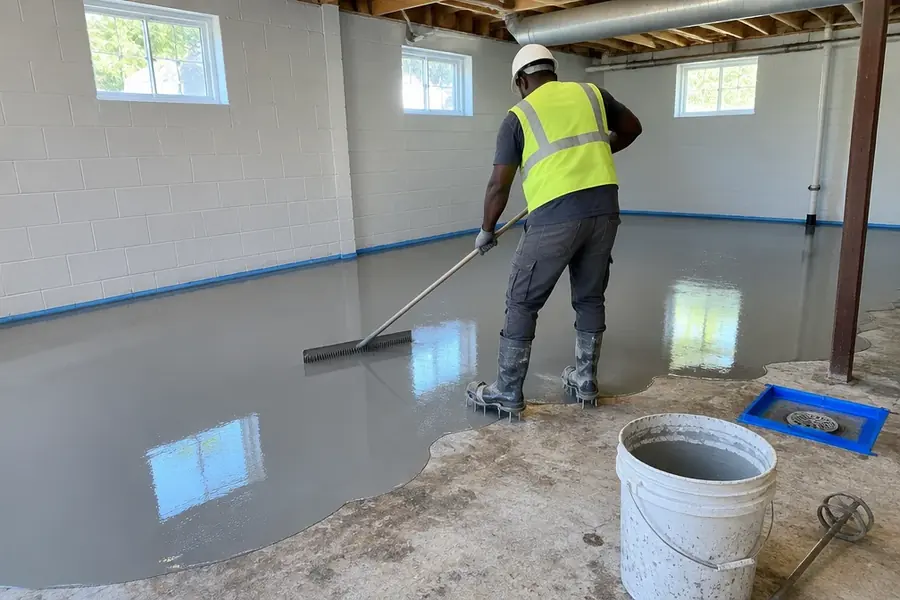
What self leveling concrete fixes
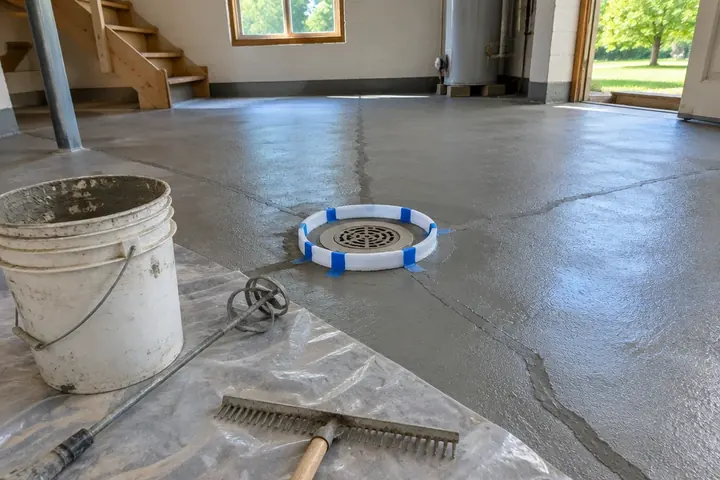
Most of the floors we flatten are basement floors that are about to become a family room, an office or a gym. Vinyl plank, tile and carpet all need a flat base. A floor that rises and dips under a straightedge will show through as gaps, hollow spots and cracked tile.
- Dips, humps and wavy trowel work in an old basement floor
- Patched trench lines where a plumber cut the floor for drains
- Rough floors left after old tile and glue come up
- Garage floors being turned into a heated room
- Small height steps between an old floor and a newer patch
When it is the wrong fix
Self leveling concrete is a thin layer that bonds to the slab underneath. It cannot hold a floor together. If cracks are still opening, or a section has dropped because the ground under it washed out, the new surface will crack along the same lines. A sunken but sound slab may be better lifted first with concrete leveling. A floor that is heaved, crumbling or only an inch thick over dirt usually needs a new concrete basement floor instead.
Water is the other limit. A basement that takes on water after storms needs that fixed first, and a slab that stays damp needs a moisture test before any flooring goes over it. Outdoor slabs need a different product, so for worn steps, walks and porches see concrete resurfacing.
Getting the floor ready
The pour is the quick part. Preparation is what decides whether it bonds. We grind off paint, glue and old sealer so the cement can grip bare concrete, then vacuum the dust. Cracks and holes are filled, and the edges, floor drains and any gaps at the walls are dammed so the material cannot run away. Then a primer goes on. Makers of self leveling underlayments call for a primer on concrete, because it improves the bond and stops air coming up from the slab and leaving pinholes in the surface.
Many older Pittsburgh basements still have 9 inch square floor tiles or black glue under newer flooring. Some of those products were made with asbestos. Do not sand, grind or scrape them until a sample has been tested. If they test positive, removal is a job for a licensed abatement contractor before we start.
How thick can it go?
Each product has its own limits, set out on its data sheet, and we follow them. As a rough guide:
| Depth needed | What we use |
|---|---|
| Feather edge to about 1/8 in | A patching or skim compound, troweled on |
| About 1/8 to 1 in | Self leveling underlayment, poured neat |
| Over about 1 in | Underlayment extended with pea gravel, where the maker allows it |
| Several inches, or a big slope | A new concrete topping or a new floor |
Basement floors with drains and sump pits
A self leveler wants to go dead flat, but most Pittsburgh basement floors are meant to fall toward a floor drain, a laundry tub or a sump pit. Flattening the whole room can send water the wrong way the next time a pipe leaks. So we decide with you which areas stay sloped. Around a drain we usually keep the fall and work that area by hand, then level the rest of the room up to it. Sump pit lids and radon pipes are protected and kept accessible.
Self leveling concrete or a new floor?
If the slab is sound and only uneven, leveling the surface costs far less than breaking it out, and it adds very little height, which matters under low basement ceilings and at the bottom of the stairs. If the slab is failing, a new pour is the better spend, and we will price both so you can compare. For garages that will stay garages, a floor coating or a new floor usually suits better, since most underlayments are made to be covered, not driven on.
How the work goes
- Check the slab
We map the highs and lows with a straightedge and look for movement and damp.
- Grind and clean
Paint, glue and sealer come off, then the dust is vacuumed up.
- Prime and dam
Cracks are filled, edges and drains dammed and the primer goes on.
- Pour and spread
We mix in batches, pour in one go and spread it with a gauge rake and smoother.
Common questions
What is self leveling concrete?
A cement-based underlayment with polymers that make it flow out flat when mixed. It is poured over a sound concrete floor to fill low spots and smooth the surface before new flooring goes down.
How thick can self leveling concrete be?
It depends on the product. Many go from about 1/8 inch to an inch poured neat, and some allow deeper pours with pea gravel mixed in. The maker's data sheet sets the limit for each one.
Does self leveling concrete need primer?
On concrete, yes in nearly every case. Makers call for their primer to help the bond and to stop air rising from the slab and leaving pinholes in the surface.
Can self leveling concrete be used as a finished floor?
Most underlayments are made to be covered with tile, plank, carpet or a coating. Some products are made as a wear surface, so check the data sheet before leaving one bare.
Can you use self leveling concrete in a garage?
Inside, under a new floor covering, yes. Most underlayments are not made for car traffic or road salt, so a garage that stays a garage is usually better with a coating or a new floor.
How long does self leveling concrete take to cure?
Most can be walked on within a few hours. Waiting times before tile, plank or other flooring vary by product and thickness, from about a day to several, so follow the maker's figure.
Does self leveling concrete crack?
It can. It will follow cracks that are still moving in the slab below, and it can crack if it is poured outside the product's depth limits or over a slab that was not primed.
Can you put self leveling concrete over tile?
Some products allow it over well-bonded ceramic tile with the right primer, but loose tile has to come up first. Old tile and black glue in older homes should be tested for asbestos before anyone disturbs it.
More concrete services
- concrete slabs in Pittsburgh
- concrete garage floors
- concrete basement floors
- concrete flatwork
- exposed aggregate concrete
- concrete footers
- shed slabs and hot tub pads
- concrete leveling in Pittsburgh
- concrete resurfacing in Pittsburgh
- concrete sealing
- epoxy garage floors
- concrete removal